Why Magic and Cultural Roots Belong Together
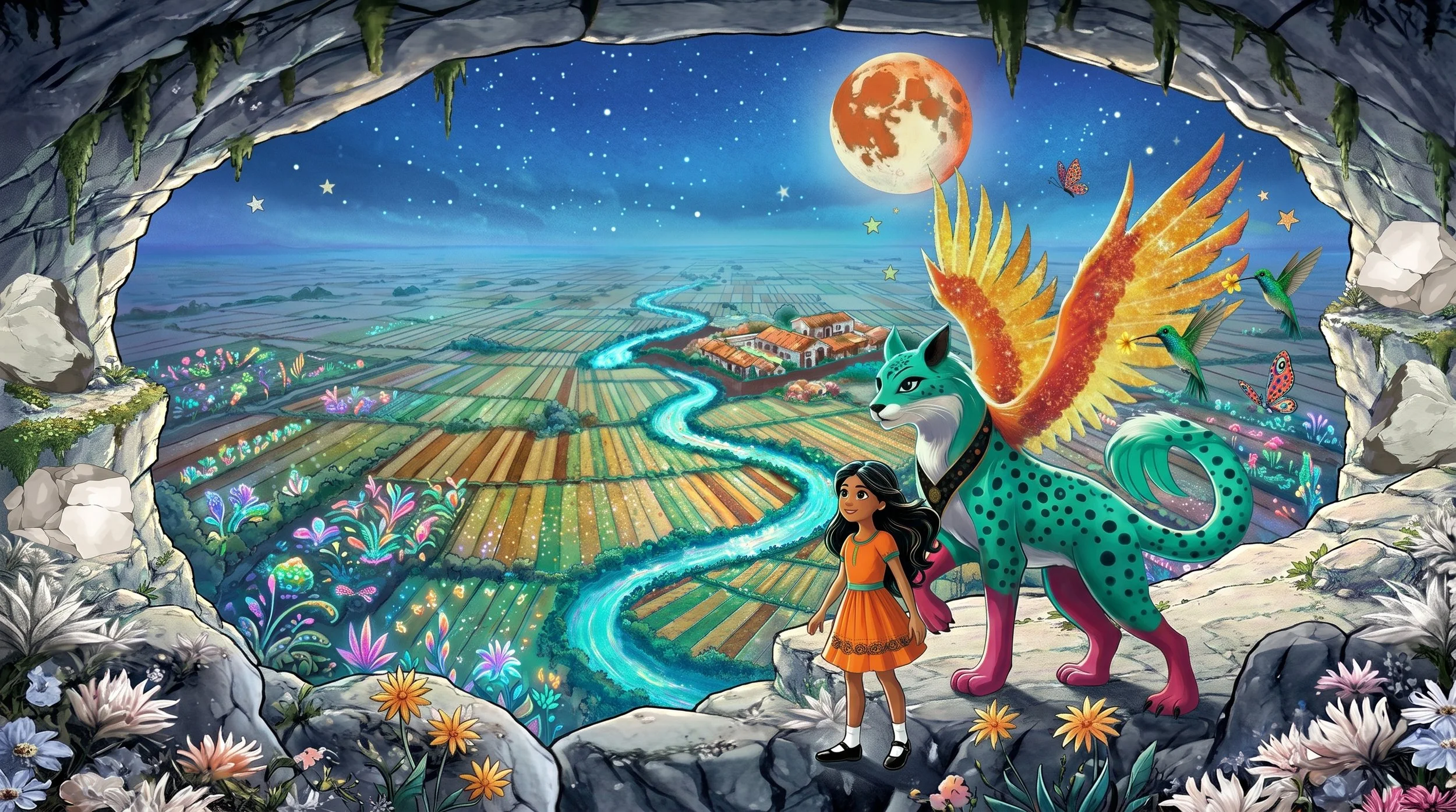
From the upcoming Guardians of El Rancho Chocolaté series: Standing at the threshold of an ancient, flower-lined cavern under a glowing harvest moon, a young girl and her majestic winged Alebrije gaze out over the enchanted porciónes along the river-woven valleys of El Rio Grande.
As my journey as an author has evolved and the stories I share continue to grow, I have noticed a familiar thread weaving through every manuscript, concept, and project currently in my pipeline. There is an unmistakable enchantment at the core of everything I write. Whether it is inspirational, motivational, deeply mystical, rooted in the ancient wisdom of a curandera, or honoring indigenous traditions and oral histories, my stories live in the space where wonder and reality meet.
Looking at this body of work made me pause and reflect: Why does magic call to me so strongly?
The answer took me straight back to my youth.
Secret Portals and Everyday Objects
My earliest fascination began with stories where the ordinary domestic world held hidden mechanisms of transport, and nowhere was that more intoxicating than in Edward Eager’s Tales of Magic series. Reading Half Magic, Knight's Castle, Magic by the Lake, and The Time Gardencompletely shifted the boundaries of what I thought was possible. Eager didn't set his stories in distant, unreachable lands; he planted wonder right in the middle of ordinary family life. A worn, tarnished coin picked up off the sidewalk yielded wishes only by half, requiring mathematical ingenuity and clever phrasing to navigate. A toy soldier in a miniature castle, a lake brimming with wild enchantments, or a garden guarded by an ancient, thyme-scented Natterjack—each book unlocked a new set of rules and logic. It taught me that magic wasn’t random; it was a craft, a puzzle, and a thrilling collaboration between the characters' wits and the hidden rules of the universe.
That same sense of everyday domestic enchantment radiated through C.S. Lewis’s The Chronicles of Narnia and Frances Hodgson Burnett’s The Secret Garden, where everyday wardrobes and overgrown wrought-iron gates served as thresholds into sacred, restorative realms. In Disney’s Escape to Witch Mountain and Bedknobs and Broomsticks, ordinary artifacts like a star-shaped harmonica case, a glowing amulet, or a brass bedknob turned to the right could channel quirky domestic sorcery, hidden legacies, and the power of substitutionary locomotion. Alongside the whimsical mechanical wonder of Chitty Chitty Bang Bang, with its flying car and secret subterranean hideaways, these tales proved that magic doesn’t require distant galaxies—it is often waiting quietly inside the drawers, baseboards, and forgotten corners of our own homes.
Micro-World Building and Cozy Sanctuaries
Equally powerful was the literature of self-contained worlds, resourcefulness, and intimate spaces. In Mary Norton’s The Borrowers and Gertrude Chandler Warner’s The Boxcar Children, the narrative magic came directly from the meticulous craft of micro-world building. There was something profoundly satisfying about seeing ordinary, overlooked, or discarded items transformed into a functioning ecosystem. A postage stamp hung as a framed painting, a matchbox transformed into a dresser, safety pins repurposed into climbing hooks, or a rusted railroad car tucked away in the pine woods furnished with chipped teacups and a makeshift shelf—these books were masterclasses in autonomy, domestic ingenuity, and the art of crafting a cozy sanctuary from scratch. They spoke directly to the builder and designer in me, showing that any space, no matter how small or abandoned, can be transformed into a home of safety, dignity, and quiet wonder.
In Maurice Sendak’s Where the Wild Things Are, that world-building turned internal, showing how a child's raw, unbridled emotions could cause a bedroom to sprout trees until the walls completely dissolved into an entire ocean and forest. In Katherine Paterson’s poignant Bridge to Terabithia, a simple woodland creek and a weathered rope swing became an enchanted kingdom, demonstrating how young minds construct mythic landscapes to navigate courage, companionship, and profound emotional truths.
Atmospheric Mysteries and Gothic Shadows
Beyond overt fantasy, I was deeply drawn to stories steeped in atmospheric tension, where the line between reality and the supernatural blurred into thrilling suspense. The gothic, "almost-magic" puzzles of The Three Investigators (Alfred Hitchcock series) and Nancy Drew kept me on the edge of the uncanny. Haunted carousels, glowing skulls, whispering mummies, and secret passageways behind book walls proved that keen observation, curiosity, and courage could decode the deepest shadows. Even when the supernatural turned out to be an ingenious trick or hidden mechanism, the emotional experience was one of pure marvel.
When that atmosphere ventured into high-stakes wonder, stories like Madeleine L'Engle's A Wrinkle in Time pitted cosmic light against consuming darkness across fifth-dimensional tesseracts, while Ray Bradbury’s Something Wicked This Way Comes captured the haunting dread of midnight carnival trains, mirror mazes, and the dark folkloric secrets carried on an autumn wind.
These stories didn’t just entertain me; they taught me how to look at the world through a lens of infinite possibility.
At first glance, one might ask: Is writing and loving these kinds of stories simply a form of escapism?
For a long time, popular culture has treated "escapism" almost like a dirty word—a symptom of dodging reality, looking away from hardships, or retreating into childish daydreams. But as both an author and a lifelong designer, I see it very differently.
Magic in storytelling is not about running away from the world; it is about reclamation, transformation, and active world-building.
The Difference Between Avoidance and Transcendence
When an artist weaves fantasy, folklore, or magical realism into a story, we aren’t erasing real life; we are elevating it.
Consider how children experience the world. To a child, the world is already vast, mysterious, and occasionally daunting. When we introduce magical elements such as a mysterious compass guiding a journey, a family recipe infused with generational healing, or a folkloric creature lurking in the shadows—we give young readers a framework to process big emotions, face real fears, and discover their own inner resilience.
Magic is the most evocative language we have for expressing profound emotional truths. It provides a sanctuary where young minds can explore courage, destiny, and belonging without being flattened by adult cynicism.
Weaving Heritage into Wonder
For me, the mystical elements in my writing are deeply intertwined with my heritage. The folklore, indigenous traditions, and spiritual resilience passed down through Mexican-American oral histories have always possessed an organic magic.
In our culture, the line between the everyday and the sacred has always been beautifully blurred. The scent of copal, the soothing remedies of herbal tea prepared with intention, the belief in signs, and the reverence for our ancestors are not far-off fairy tales; they are lived traditions.
By framing these cultural cornerstones within the grand traditions of magical and inspirational literature, I am not trying to build a fantasy land detached from who we are. I am building a doorway. I want readers of all backgrounds to step through that doorway and see our heritage celebrated with the same majesty, wonder, and epic scale as the classic fantasy worlds that shaped my own childhood.
Designing a Brighter Lens
After spending over three decades in design, constructing garments, textures, and visual narratives, world-building comes naturally to my soul. Taking raw elements—a childhood memory, an ancestral story, a poignant life lesson—and wrapping them in vivid color, rich texture, and a touch of the mystical is simply how I interpret life.
So, is it escapism? Only in the truest, most empowering sense of the word.
It is the freedom to look past the mundane, to re-enchant our daily lives, and to remind children (and the adults reading along with them) that wonder isn't something you leave behind when you grow up. It is something you carry with you, woven into your roots, waiting to be rediscovered on every page.
A Question for You: When you think back to the books that shaped your youth—whether it was unlocking a secret garden, discovering a hidden world beneath the floorboards, or solving a nighttime mystery—what was that one unforgettable moment that opened the doorway of wonder for you? Share your favorite titles in the comments!