From the Soil to Seventh Avenue
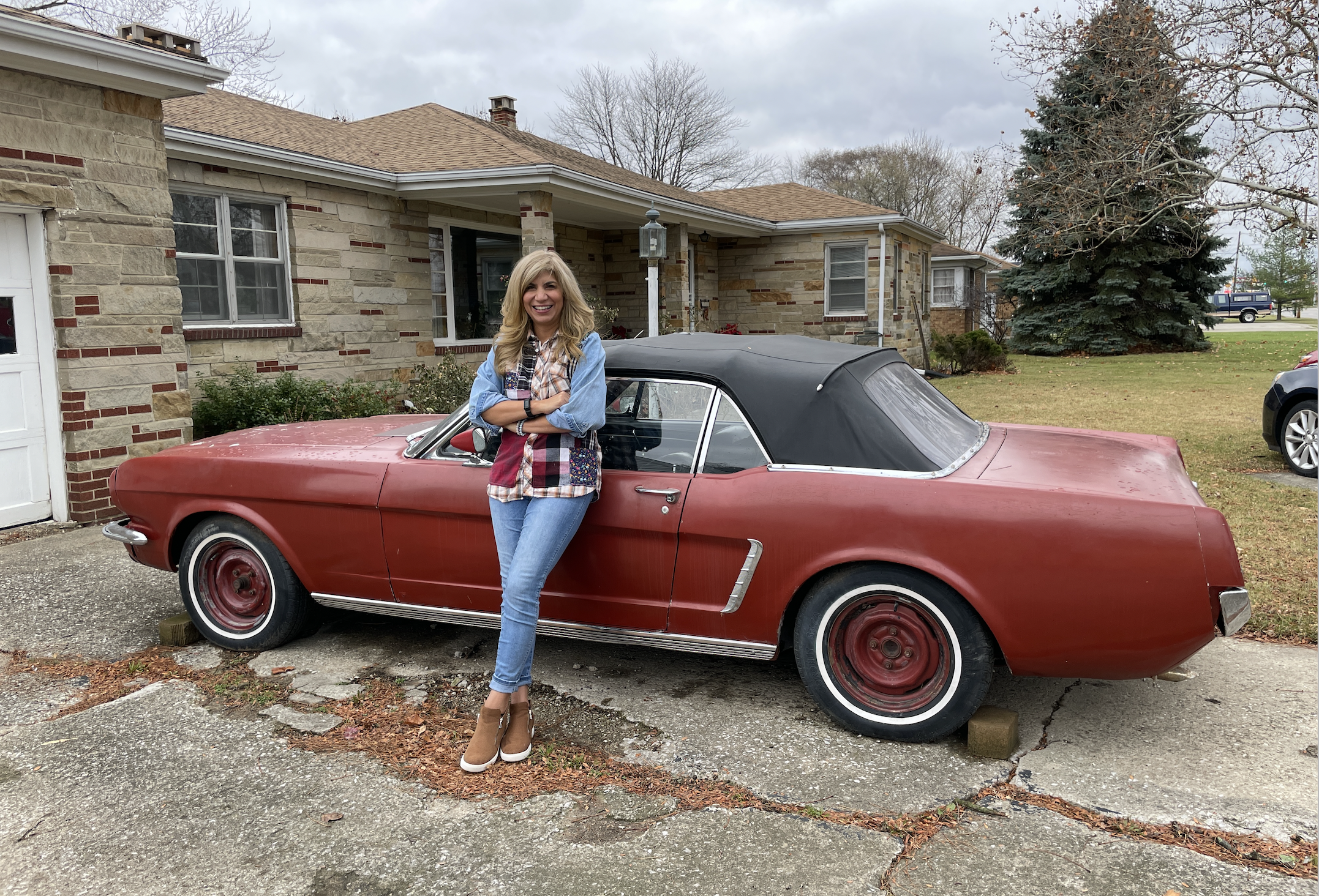
The red mustang that started it all. High fashion dreams and vintage horsepower—me and the temperamental '65 Mustang that got me to the factory floor (and sometimes left me on the side of the road).
In the summer of 1991, my compass was set firmly on New York City. I had started at Bowling Green State University in 1988, enrolled in the four-year Bachelor of Arts in Fashion Design program. By the time I reached my junior year, I was working toward a rare and competitive opportunity: if accepted, students spent their senior year in a visiting transfer program at the prestigious Fashion Institute of Technology in New York City, earning an Associate of Applied Science degree alongside their BGSU degree.
I poured everything into the application, submitting a rigorous portfolio filled with fashion illustrations, technical flats, and actual garments I had patterned and constructed from scratch. When the acceptance letter arrived, I was ecstatic—I could hardly believe I had made the cut to study on Seventh Avenue. Then came the bureaucratic gut-punch: FIT had run completely out of on-campus housing for out-of-state students. My start date was shoved back five months to late January 1992. It was going to be a little detour before I could start living the dream I had envisioned all my life.
Manhattan wasn't going to pay for itself, and sitting around Defiance waiting was out of the question. I needed cash, and I needed it fast.
That was how I found myself turning through the gates of Campbell Soup in Napoleon, Ohio.
The name Campbell wasn’t just a label on a red-and-white can in our pantry; it was woven into my family’s marrow. Decades earlier, the vast tomato fields feeding those same canning lines had been one of the stops on my mother’s migrant circuit. She had bent her back under the punishing Midwest sun, working the dirt to help pave a way forward for the next generation. Now, thirty years later, her college-graduate daughter was walking onto that same corporate footprint. But my shift wasn’t under the sky or on the deafening cannery floor. I was headed into the quiet, sterile twilight of the mushroom spawn laboratory.
Whenever people think of Campbell in northwest Ohio, the mind instantly goes to tomatoes—the sprawling summer harvest, the heavy scent of simmering tomato paste filling the autumn air, and the iconic condensed soup cans painted by Andy Warhol. Mushrooms seem almost secondary by comparison, a quiet pantry staple hidden behind the red label of a Cream of Mushroom can or folded into green bean casseroles. Yet behind the scenes, Campbell was running one of the most sophisticated, proprietary agricultural operations in the world.
To feed millions of cans annually without relying on unpredictable open-market crops, Campbell engineered and controlled every stage of its mushroom supply chain. The Napoleon spawn laboratory was the foundation of that entire system. Pure, laboratory-grade spawn was the engine: by inoculating grain under sterile conditions, they could dictate the exact strain genetics, flavor profiles, and disease resistance before the mycelium ever touched a compost bed in their growing houses. It was a billion-dollar culinary empire built on the quiet science of microscopic fungal threads.
The work was part science fiction, part pure physical grind. In sealed clean rooms, lab techs worked under laminar-flow hoods, injecting live fungal cultures into quart glass jars loaded with sterilized grain. My job started once the biological clock began ticking.
Every single day, hundreds of those jars passed through my hands for a vigorous, rhythmic shake. The goal was to break apart the tight, rubbery webbing of white mycelium as it colonized the grain, forcing the fungal threads to scatter and multiply. But it was always a game of Russian roulette. Between natural gas pressure building inside the sealed jars and glass structurally fatigued by endless rounds in blistering autoclaves, you held your breath with every hard shake. You braced your wrists and prayed the jar wouldn't detonate in your grip.
Once shaken, the bottles were loaded into towering, multi-tiered steel rack systems fitted with specialized rolling cradles. Fully loaded with hundreds of jars of dense, damp grain, someone on the floor told us each rig weighed close to a ton. Moving them wasn't a solo task. It took two of us throwing our entire body weight into the steel, heels digging hard into the sealed concrete, steering those massive behemoths into the warm incubation bays.
When the jars were finally blanketed in pure, snow-white growth, we wheeled them into the deep cold-storage vault. The temperature drop hit your chest like a wall of ice. The freezing air put the living mycelium into suspended animation, halting its growth before it could spoil. Overhead, narrow-aisle electric lifts hummed through the frost, hoisting pallets of dormant spawn skyward into towering industrial racks to await the refrigerated transport trucks.
My daily transit to this surreal world was its own adventure. I drove a cherry red 1965 Mustang—a gorgeous, stylish classic that had far more personality than reliability. The commute was just short enough that I gambled on it every morning. But this was 1991, long before cell phones existed to rescue stranded drivers, and one afternoon on the rural road heading home, she finally gave up the ghost. The engine died, and I coasted onto the gravel shoulder surrounded by flat, endless Ohio farm fields.
When a car finally slowed down and pulled in behind me, relief hit—until the driver rolled down his window. He didn't ask if I needed help or if I was okay. He looked past me at the vintage lines of the car and flatly asked how much I wanted for it.
I left the lowballer by the roadside and started walking the gravel toward the nearest farmhouse. I knocked on a stranger's front door, asked to use their landline, and dialed home. Soon enough, my dad was driving out to find me, ready with tools and patience to tow his daughter and her stubborn red car back to safety.
Looking back, that five-month detour was never really a delay; it was the prologue.
There was poetry in navigating that vintage red Mustang down flat country roads, a young woman with sketchbooks full of silhouettes and a head full of high-fashion dreams, heading into an industrial lab to muscle one-ton steel racks and coax living mycelium into growth. The car was temperamental, beautiful, and unapologetically bold—not unlike the ambition it took to believe a kid from northwest Ohio belonged in the competitive fashion showrooms of New York City.
More than anything, those months anchored me to the shoulders I stood on. Every dollar I saved inside that facility carried the quiet resonance of my mother’s labor decades earlier in those very same tomato fields. Her hands had worked the earth under the sun so that one day, my hands could drape fabric, cut patterns, and tell our stories on the world’s stages.
Looking back, that five-month detour taught me lessons that no classroom ever could. There is profound dignity in factory work, and you never make light of any job that puts food on the table or fuels your ambitions. In that lab, I learned precision, physical stamina, accountability, and the unmistakable bond of leaning into heavy work alongside coworkers who became trusted allies on the floor. Big creative dreams don’t exempt you from the reality of needing to earn a living; they simply demand that you respect every single rung of the ladder that gets you there.
When January of 1992 finally rolled around and I boarded the train from Bryan, Ohio for the journey east to Seventh Avenue, I didn’t leave northwest Ohio behind. I carried the grit of the factory floor, the patience of the craft, and the enduring resilience of the women who came before me. The path to couture isn't always paved in silk—sometimes it's forged in heavy steel, rural grit, and a bold cherry-red classic that I refused to ever give up.