A South Texas, St. Patrick’s Celebration
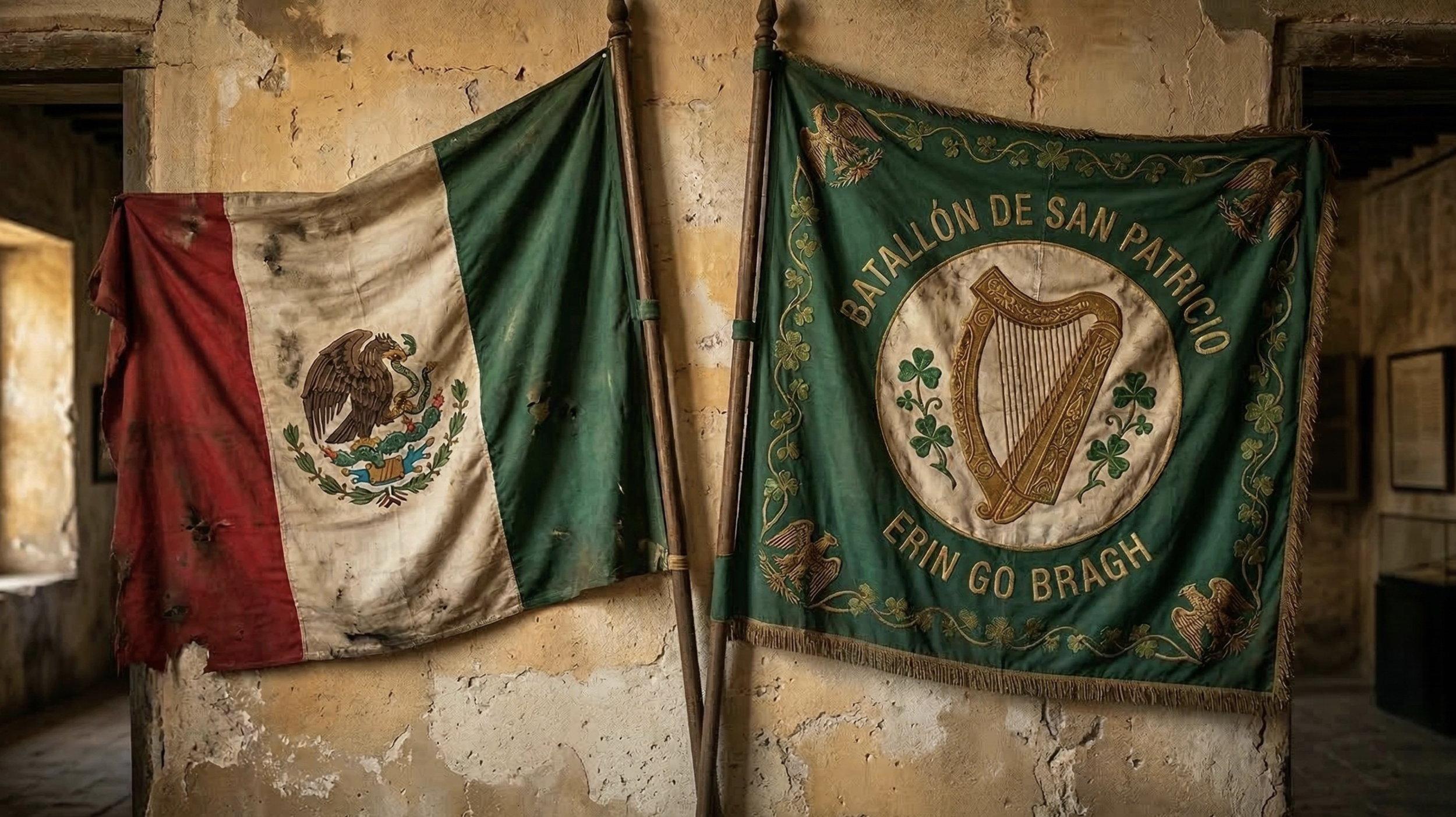
The Story of the San Patricios
The story of the Batallón de San Patricio is one of the most poignant "forgotten" chapters of North American history. It is a story of shared identity, and the literal merging of the Harp and the Eagle.
I had a complete "aha" moment this week. While looking into the demographics of South Texas in the 1940s and 50s, I expected the usual suspects—the foundational Tejano families and German names too, but I also saw Irish names and had not researched how they had come to arrive in what is now South Texas. As a creative, I think of our American history like woven fabric; the "borderlands" have deep threads of many cultures running through them. It’s a massive, cross-cultural merger of the Harp, the Accordion, and the Eagle.
The story makes so much more sense when you look at the specific timeline of how these groups arrived. Throughout the 1830s and 1840s, a wave of European migration hit the Gulf Coast. They heard about this wild frontier through "America Letters"—glowing, viral accounts sent back home by early pioneers—and the work of Empresarios, colonial scouts hired by the Mexican government. They promised fertile land and, equally important, religious freedom to Catholic Europeans who were weary of the hunger and political upheaval in the Old World.
The Irish brought the "software" of the spirit. They didn't just come for the land; they came with a "rebel heart" created from centuries of resisting an empire back home. Settling towns like San Patricio (founded in 1829) and Refugio (founded in 1834), a name that translates to "Refuge" or "Sanctuary." For the Irish fleeing British persecution, it was a literal description of the life Mexico offered them.. The Irish brought a mastery of horsemanship and cattle raising that felt like a mirror image of the Mexican vaquero tradition. They brought a fierce, unbreakable Catholic faith that bonded them instantly to the Mexican people. The Irish were the storytellers and the poets of the brush country, blending their ancient fiddle melodies with Mexican folk songs.
The Germans brought the technical "hardware." Establishing hubs like New Braunfels (founded in 1845) and Fredericksburg (founded in 1846), their influence flowed straight down into the Rio Grande Valley. They arrived with the mastery of the Metzgerei (the butcher shop) and changed our culinary landscape forever. Before they arrived, meat was often just salted or dried into carne seca. The Germans introduced the art of curing and cold-smoking—using European science to turn a tough Texas brisket into a smoky delicacy.
But their "engineering" went beyond the smokehouse. While the Spanish Plaza had existed in Mexico for centuries as a social and religious center, the Germans re-engineered the economic function of the town square by building specialized storefronts that operated as precise business machines.. They introduced purpose-built breweries and commercial meat markets. They brought the science of lagering, introducing bottom-fermentation to create crisp, cold beers that could survive the Texas heat, unlike the heavy ales of the past. By building these specialized industrial hubs, they provided the commercial backbone that allowed the ranching industry to scale into a global powerhouse.
But these men carried more than just their trades; they carried a profound conflict of conscience. During the Mexican-American War (1846–1848), many European immigrants found themselves in a U.S. Army uniform, being ordered to invade a nation that shared their Catholic faith. They faced a choice: loyalty to a military that often treated them as second-class citizens, or a shared destiny with the Mexican people.
This tension birthed the Batallón de San Patricio. Led by John Riley, this was an international unit where Irish and German Catholics fought side-by-side as brothers. These men chose their conscience over their orders, defecting to form an elite artillery unit for Mexico. Fighting under a stunning emerald green banner featuring the Irish harp and the image of St. Patrick, they became some of the most celebrated heroes in Mexican history. It was a brotherhood of the borderlands built by those brave enough to defend their values.
By the 1940s and 50s, this wasn't just history; it was a way of life. Irish and German lineages had woven themselves so tightly into Mexican-American culture. You could hear it in the music—where the German button accordion met the lyrical storytelling of the Irish-Mexican tradition to create the very heartbeat of South Texas.
Connecting these dots makes March 17th feel like more than a holiday; it’s a true celebration of our roots. Today is also the birthday of my father, Tristan. I used to think it was just a quirky coincidence that his birthday fell on St. Patrick’s Day, but seeing this history, it feels like it was meant to be.
Though he grew up in a tough environment, my dad has always been the one to bring people together, using stories to bridge the gaps between us. Seeing him pick up the accordion—an instrument that traveled thousands of miles to become the soul of our music—it all clicks. He carries that sentimental Irish spirit and that gift for gathering everyone around a shared song. He’s spent his life ensuring that the music and the heritage don't just survive, but that they keep us connected.
So, here’s to the San Patricios, the pioneers of the Valley and the Hill Country, and a very Happy Birthday to my Dad!
¡Que viva México! ¡Que viva Irlanda!