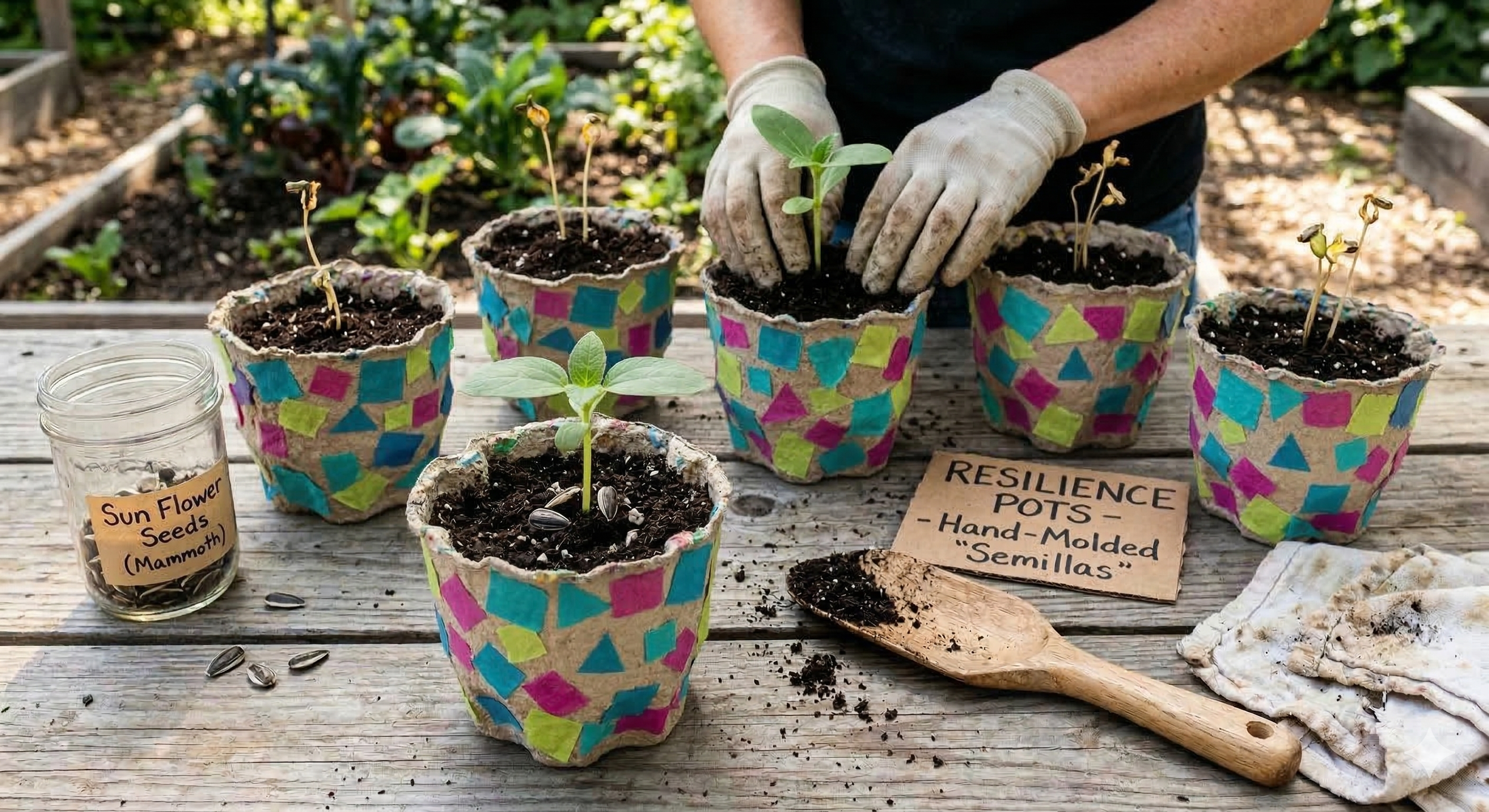
🪴A Sustainable Seed Starter Workshop
As the spring equinox and Earth Day draw near, I find myself looking back at a legacy of resilience that defines my family—and my book, El Camino del Destino.
This past winter in New York, as I watched the snow pile against my door, my mind traveled back to the winter of 1949. My father was caught in Wyoming’s "Storm of the Century," a blizzard so relentless it paralyzed the high plains. While many might wonder why a migrant family would be in the freezing north so early in the year, but the answer lies in the strategy of survival and the practicalities of the agricultural industry.
Sugar companies and ranches knew that moving thousands of workers from South Texas all at once right before the beet "blocking" season began was impractical and costly. To solve this, they encouraged families to arrive early or stay through the winter in "Mexican Colonies," providing housing so the labor force was already in place. By being there in January, families like mine could secure the best farm contracts and work secondary jobs, like feeding livestock, while they waited for the ground to thaw.
The journey from La Grulla, Texas, to Wyoming is nearly 1,500 miles. In 1949, that meant days of navigating unreliable roads in search of opportunity. My family was met with a storm so massive the National Guard had to deploy armored vehicles to rescue stranded travelers. For a family used to the temperate palm trees of the Valley, this frozen landscape was a world away. Yet, they weren't deterred. They were headed toward a season where an entire family, working together, could earn roughly $12 to $20 per acre—a sum that, at the time, represented a year of hope and stability.
They didn’t see the impending "stoop labor" as a burden; they saw it as a collective mission. It was a time of reunion, meeting up with other migrant families who became lifelong friends, all bound by the shared excitement of the journey and the prospect of a successful harvest.
When I look out at my yarn in Tappan today, watching the last of the New York snow melt into the soil, I feel that same stir of excitement in my bones knowing I’ll soon be looking at a beautiful lush green garden soon filled with fruits, vegetables, and flowers . But for me, the labor of making this happen is not born of a desperate necessity for survival, but of a deep, intentional choice. My "backbreaking" work is a labor of love—a way to stay connected to the earth that my family knew so intimately. In the coming months, I will plant my own seeds and seedlings, tending to a harvest that feeds my soul just as much as my table.
🌱From History to Hands-On: The "Semillas" Workshop
As I sat down to plan my next book reading, I knew I wanted to do a reading of El Camino del Destino because of the theme of planting and harvesting and I wanted to offer the children something more than just a story. Initially, I thought we would simply plant seeds to take home, but the creative spirit took over as it usually does with all my projects. I thought: Let’s make something that is aligned with Earth Day and the idea of Spring renewal.
Instead of buying plastic or store-bought starters, we are creating our own molded pulp "Resilience Pots." This project is more than just a recycling lesson; it is a space where I can talk to the children about the importance of taking care of our planet. Just as my father and his family cared for the soil in Wyoming, these children are learning to connect with nature, to nurture something living, and to understand that beauty can be constructed from the most humble, discarded materials.
This is a wonderful Earth Day activity to do with your family. We take what is "old"—egg crates and brown paper bags—and transform them into a vibrant vessel for a new destiny.
📖 A Recipe for Renewal: Hand-Molded ‘Semillas’ Pots
In the fashion industry, we talk about "sourcing" and "composition." In my garden, I talk about "intention." This recipe combines both. It transforms discarded paper into a sturdy, biodegradable vessel designed to nurture new life.
Yields: Approx. 6–8 starter pots (depending on mold size)
Prep time: 20 minutes (plus a 24-hour soak)
Dry time: 48–72 hours
The Ingredients
2–3 Cardboard Egg Crates: These provide the porous, breathable bulk.
1 Large Brown Paper Bag: This adds the "long-fiber" strength needed for durability.
3 Sheets of Colorful Tissue Paper: Cut into very small pieces.
Water: For the infusion process.
1 Pinch of Patience: The most critical ingredient for any "Camino."
Potting Soil
Sunflower Seeds (I love Mammoth sunflowers)
8 to 10 Small Drinking Glasses or Small Jelly or Juice Jars: Using glass or strong plastic for your mold is best to be able to apply pressure when molding the pots.
(If you plan to make the pots in bulk, you can aim for the perfect balance of strength and beauty - a mix of 60% egg crates for bulk, 30% brown paper bags for durability, and 10% colorful tissue paper for that unique marbled flair.)
The Instructions
Prep the Fiber: Tear your egg crates and brown bags into small, one-inch pieces. The smaller the tear, the smoother the pulp.
The Deep Soak: Place the pieces in a large bowl and cover completely with water. Let them sit for 24 hours. This breaks down and softens the fibers.
Create the Pulp: Working in batches, place the soaked paper into a blender or use an immersion blender. Fill with enough fresh water to cover the paper by two inches. Pulse until the mixture reaches a thick, oatmeal-like consistency.
Add the Artistry: Pour the pulp mixture into a mixing bowl. Let the children hand-tear the colorful tissue paper into the mix. Stir gently by hand—you want the colors to marble, not blend into a single muddy shade.
Extract & Mold: Strain some of the excess water out, but leave the pulp mixture with enough liquid to feel like damp modeling clay.
The Construction: Press the damp pulp to the outside of your glass or jar and up the sides to mold your pot . Aim for a thickness of about 1/4 inch.
Use a pencil to poke a drainage hole in the bottom while the pulp is still wet.
The Cure: Place your glass jars with the curing peat pots in a sunny or breezy spot. They must be bone-dry before you add soil—this usually takes 2 to 3 days.
The Planting
Once the pots are formed and dried (a lesson in patience, another key component of resilience!), it’s time for the stars of the show: sunflower seeds.
I chose sunflowers for a very specific reason. In El Camino del Destino, the characters must learn to navigate challenges, find their resilience, and trust their path. Sunflowers are the ultimate expression of this journey. They practice heliotropism—they constantly turn their faces to follow the light of the sun, from dawn to dusk. Sunflowers are also just so fun and vibrant out in the garden!
Once your "Resilience Pot" is dry and sturdy, fill it with rich potting soil. Plant your sunflower seed one inch deep, give it a little water, and place it in the light. When the seedling is a few inches tall, plant the entire pot directly into your garden. The paper will dissolve into the earth, allowing the roots to find their path without ever being disturbed.
🌎 A Call to Your Own Camino and to Earth Day
This activity is a small reminder that creativity and care for the earth are not separate pursuits. They both require thoughtfulness, resourcefulness, and a belief in the power of growth.
This Earth Day, I invite you to find your own "Recipe of Resilience" in the garden, with your family, or simply by observing the persistent light-seeking journey of a sunflower.
How are you connecting to the earth and finding sanctuary this month?