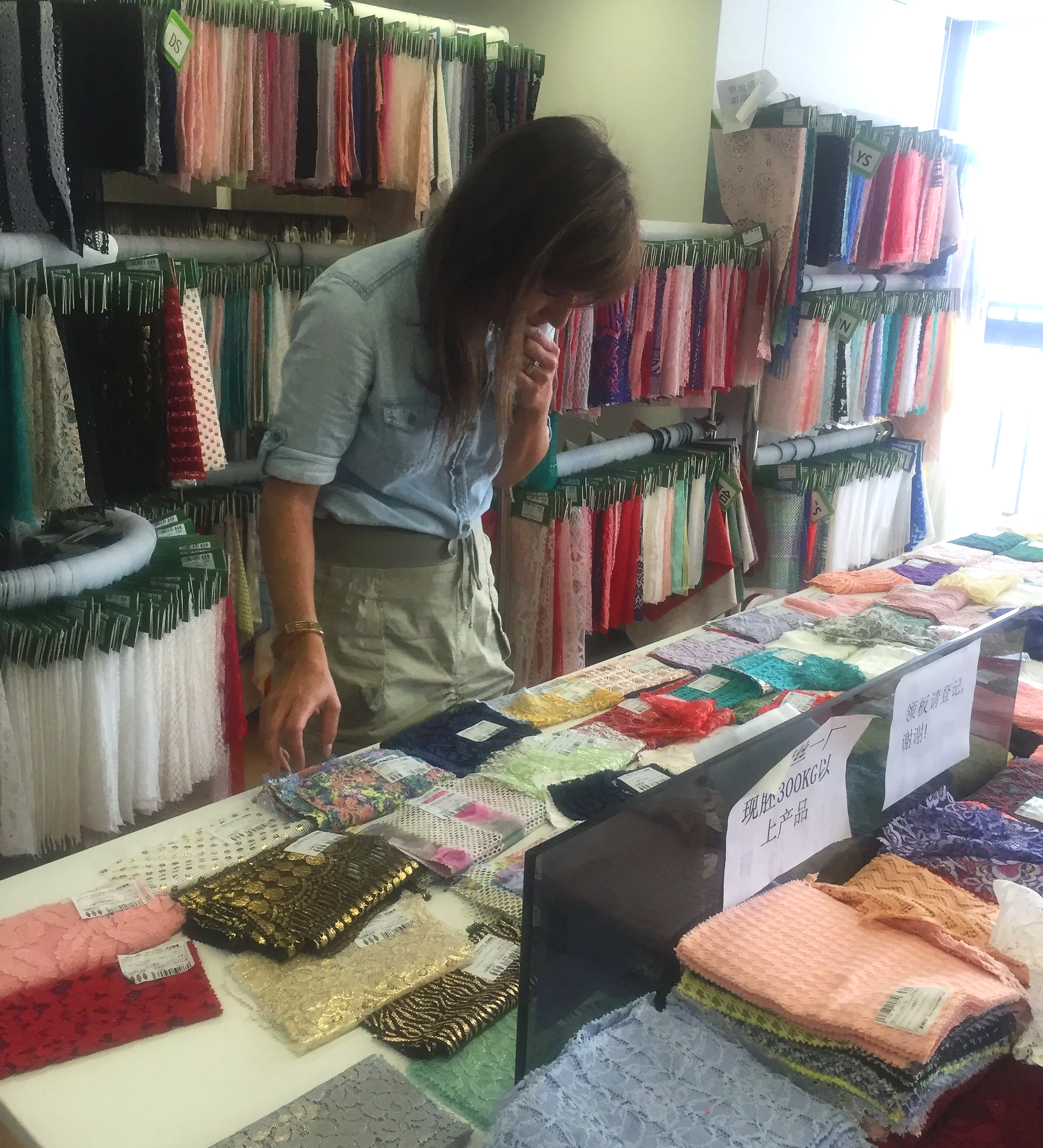
A day at an overseas fabric resource in Ningbao, China selecting fabrics for my celebrity brands.
A Journey Back to the 1990s
Preparing for the FIT Alumni Womxn’s Empowerment Conference that was held last week, sent me down a very nostalgic and deep, reflective "rabbithole" of my own career trajectory. As I gathered my thoughts for what I wanted to say, I found myself mentally walking back through the doors of FIT in 1992, remembering the person I was—a small fish in a very big ocean. Coming from Ohio, I was a very headstrong and creative young woman who clearly had the talent to be selected for such a prestigious fashion design program. In my Ohio surroundings, I felt pretty confident, but the moment I entered the halls of FIT, that confidence was tested. I was suddenly surrounded by an ocean of talented, bold students, many of whom were not at all shy about expressing exactly how amazing they were. It was as true as the episodes we watch of Project Runway—that intense, high-energy atmosphere where every hallway feels like a catwalk and every workroom is vibrating with the ambition to succeed.
Before I even arrived at FIT to earn my degree in Fashion Design, I already had a good eye for creative vision and an instinctive ability to tell stories through that creativity. I had grown up as a young girl watching my mom run her own bridal shop—I just hadn't yet honed those design and storytelling skills for the corporate world. Today, we use sophisticated phrases like "Brand Building," "Narrative Strategy," or "Content Creation," but at their heart, these are all really just highly specialized extensions of that original storytelling skillset.
And because I carried that “small fish, big ocean” syndrome with me, I wasn’t always secure in my own words, I leaned into listening intently early on. I needed that extra beat to gather all the data points, process my thoughts, and clearly speak with confidence. What I realize now is that this technique, which I once used as a crutch actually became one of my greatest assets. It became a way to quickly analyze a situation before I spoke.
This practice of deep listening became my superpower when working with major brands and celebrities. It allowed me to hold the space for them to pour out their opinions, desires, and the specific aesthetic they envisioned, while I acted as a sponge for every detail. Over the years, I’ve refined the art of processing that information in real-time and nuancing it to fit a brand's DNA so perfectly that when I present the vision back to them, they see themselves in it. It’s about making the client feel that the result is authentically theirs. By the time I finally do speak, I’m not just giving an opinion; I’m offering a vision grounded in a strategic point of view.
In the early days of the ‘90’s, my career was built on the factory floors of the Bronx and Queens. I can still recall the physical closeness to the craft: being in a factory full of loud knitting machines, watching the knitting come down from the machines, cutting pattern pieces, sewing samples myself. My career actually started in sweater design because I had taken knitwear classes for my sportswear specialization and loved it. I added it as a skill set on my resume and companies jumped at my resume because it was such a niche skill. In 1992, billions of dollars of domestic sweater production for stores like Walmart, Target, Mandees, Kmart, and JCPenney were being done in Queens and the Bronx.
When I wasn’t in the factory, I was in the showroom working on designs. I sketched by hand with markers. I had an in house artist who designed our prints. She would paint one large “repeat” of a print which we would then have to color copy and reduce in size on the copier to look like the appropriate scale for a drawing of a garment that was about 3” high. We’d draw on top of the color copy, shade it in with grey markers to give it depth and style lines. We’d cut them out and tape them to presentation boards. It was tedious work and the color copier was our best friend.
Digital and proprietary design tools like U4ia, Color In Concepts, and NedGraphics were just coming into the market and cost somewhere around $40,000 per workstation. It was a huge investment for a company. Today’s tools like Illustrator and Photoshop are universal graphic design tools and have lowered the barrier to entry into design.
When production moved off-shore to China in the late 90s and 2000s, it took a lot of new learning to understand different machines, yarn sizes, and dying and finishing processes. More than that, it meant learning another culture and communicating via the internet in its early days. I started traveling to China to work closely with the factories, and the culture shock was far more profound than my move from rural Ohio to New York City.
Navigating the daily reality of those trips was an exercise in adaptability. You quickly learned that bathrooms were a gamble; even in fine dining establishments, you were often squatting on the ground, and you never, ever forgot to bring your own toilet paper. In some factories, the facilities were simply a trough of running water that you squat over—a stark reminder of the different worlds we were bridging.
However, the hospitality was as extreme as the facilities. Dinners were large extravaganzas where, as the American guest, you were always the guest of honor, offered the "best" choices that often tested your resolve. Our hosts truly meant well; they wanted to provide us with the highest honors their culture had to offer. This is when I learned to use chopsticks (still working on that one), I was given the opportunity to selecting my own live duck for our meal, and I’ve sat through courses of puffer fish, half-convinced it might be my last meal. The attempts to cater to American tastes were equally sincere and memorable; I’ll never forget being served "special" pizza where the sauce was nothing like home, and the crust featured a perimeter of mini hot dogs—a thoughtful, if slightly surreal, nod to what they believed was quintessentially American.
Trends moved with a very different speed in that era. Without the instant connectivity of the modern internet, it could take a full year for a silhouette or a color story to travel from metropolitan trend centers like New York, Paris, or London to the mid-American market. To keep our private label clients and celebrity brands ahead of that curve, I entered an intensive era of global trend-spotting that required making multiple international trips every year.
London and Paris were mandatory stops, but depending on the season’s aesthetic, I would expand the route to include Barcelona, Milan, Amsterdam, Dusseldorf, Stockholm, Edinburgh, Dublin, Copenhagen, Hong Kong, and Montreal, along with regular domestic sweeps through Los Angeles and Miami. The goal was to physically see trends emerging on the streets and in the boutiques before they trickled down.
This was a massive logistical undertaking. I would return from these 3 to 7 day trips with 3 to 5 military-grade rucksacks—bags literally the size of body bags—stuffed with garment samples purchased as physical reference points. These weren't just random hauls; they were strategic data points. We were designing for women, men, children, and juniors, across every classification from tops and bottoms to skirts and dresses. Every sample in those bags had to move the needle for our major business divisions and celebrity partners.
However, the shopping was only half the battle. Once the day ended, the "hotel room factory" began. Our protocol was strict: to comply with customs regulations, every single one of those 300 to 500 samples had to be "mutilated"—we had to cut holes or mark them so they couldn't be resold. Then came the meticulous labeling and photographing of every piece. We would be up until all hours of the night, ensuring that the second those bags arrived at the office, they were logged and ready for action. We had to be fast; back in New York, the sales teams were like piranhas, waiting to get their hands on that fresh intelligence so they could immediately reach out to their accounts.
As time went on, that thing that happens to you when you continue to grow and learn more skills happened to me. I was called on to transition from the actual hands-on designing to the managing and presenting roles of a design director. This required an upgrade to my set of tools. Although it felt a bit like I was leaving my craft behind, I was really learning to scale a vision through others. This transition also required a heightened sense of confidence.
This is when you have to be able to put yourself on the same level playing field as industry heavyweights, including high-level C-suite retail executives. It’s about owning your expertise so you can stand in those rooms as a peer and command a high-level presentation or lead a design team. Beyond this, I had to develop the business acumen to navigate the financial side and the narrative strategy to build "Brand Architecture". Learning to manage people became a design skill in itself; it’s about making an environment where the best work can happen. I spent years translating visions for others, whether it was high-volume private label design for accounts like Kohl’s, Target, Dillard's, White House Black Market, or Loft - or the amazing collaborations I led with celebrity icons including the high energy of Wendy Williams, the classic American style of Brooke Shields, and the rock-and-roll aesthetic of Adam Levine.
Eventually, the industry shifted again. The 'behemoth' retailers we had been working with began moving their design teams and factory bases in-house. A particularly disheartening aspect of this shift was a growing trend where companies would lean on us for our global market intelligence and sample development, only to unceremoniously move on without doing business, claiming they had 'found a better direction' elsewhere.
It was incredibly frustrating to later walk into those same stores and see a garment on the floor that was the exact iteration of what I had presented months prior. There was no recourse in that system—it was simply the way the giant moved. This practice was a catalyst for me; it made me realize I needed to pivot to a space where my expertise wouldn't just be mined, but valued. I knew it was time to move the needle and to start buidling for myself.
That led me to launch my own company, Tocaya Design, which had two arms. One side was consulting for mid-sized brands, utilizing my private label skills and a reputation for handling the entire process from creative concept to delivery of goods to a US warehouse. The other was launching my own brand, Tocaya, which marked the beginning of a slow lean into my heritage.
Simultaneously—and I don’t know if it was coincidence or destiny—I became a partner at Latin Biz Today, which is when I truly fell down the "rabbithole" of understanding and appreciating my Latina roots. At Latin Biz Today, I connected with amazing Latino entrepreneurs and finally got comfortable with my own story. In that space, I realized everyone’s journey was unique, and mine was just as vital as theirs.
Leaning into these ventures for the next 7 years meant mastering a completely new framework because it was just me running my business now. I was not just the designer, sketching and providing technical specifications for the garments. I was procuring materials, managing domestic sampling and production, handling order fulfillment for both wholesale and DTC, all while teaching myself website development and generating new leads. I was suddenly the one advertising, running fashion shoots, and coordinating fashion shows.
With Latin Biz Today, the learning curve continued into conducting interviews, podcasting, managing social media campaigns, and event coordination. Both ventures revolved around centering myself in my Latina culture, a part of my heritage I had neglected for too long. I realized that success isn't just a title at a major firm; it’s the ability to take 30 years of "Brand Architecture" and apply it to a niche that actually matters to you and your community. Meaning comes when your professional expertise and your personal identity finally move in the same direction.
As time went on, and I think this happens to many of us as we gain wisdom, I began to reprioritize what was truly important: family, authenticity, and doing things on my own terms. This is when my venture as an author was born. I realized I had so many stories in my head that felt exactly like the collections I used to envision. I simply transferred the entire business engine I had developed over 30 years into a different creative form: authorship. Going from building for brands to building my own personal brand through storytelling made me realize that my heritage and these family stories are really the most valuable "brand" I will ever manage.
Today, as I look at students entering an industry redefined by AI and digital speed, I tell them that "technical bones" are more important than ever. Anyone can create a beautiful rendering with AI, but if you don't understand the "bones" of your craft—the specs, and construction—your career will have a short shelf life. I shared these three hard-won truths with the students as non-negotiables for a successful career:
AI is a Tool, Not a Tailor: I recently consulted on a project where the Senior Designer and Technical Designer couldn't even provide basic measurements for a collection they were developing for a very well known plus size brand; they were so enamored with their digital images that they couldn't see past the sketches to how a garment actually fits a physical, moving body. They had not thought of how to get their designs on to the human body with zippers or buttons. If you can't translate a 2D prompt into a 3D reality, you aren't a designer—you’re a spectator.
Technical Knowledge is "Career Insurance": Trends will change, and software will be updated, but understanding every link in the chain of the fashion business—from the creative concept, to the design, technical specifications, collaboration, costing, working with factories and understanding the time and action calendar of the fashion business are so important to career longevity. When businesses look to trim the fat, they don't let go of the people who actually know how to build the product and protect the margin. If you understand the how and the how much behind the what, you aren't just a designer; you are a business asset.
Authenticity is Your Only Proprietary Asset: In a world where AI can replicate styles and "behemoths" can copy designs, the only thing that cannot be manufactured or stolen is your unique perspective. For a long time, I stayed quiet and tried to fit a mold, but I eventually learned that my Mexican-American heritage and my family’s history were the most valuable "brands" I ever managed. Don't wait to bring your full self to the table.
My journey has been a transition from necessity to choice. I moved from the part of my career where I had to say "yes" to survive, to the part where I get to say "yes" to what I love. Meaning comes when your professional expertise and your personal identity finally move in the same direction.